01
Human Factors & Human Performance
Operational adaptation, cognition, attention, workload, and transition between environments.
How Remote Warfare Systems Follow Operators Home
A short professional discussion text examining the operational patterns remote warfare demands and what can happen when those adaptations persist beyond the environment that created them.
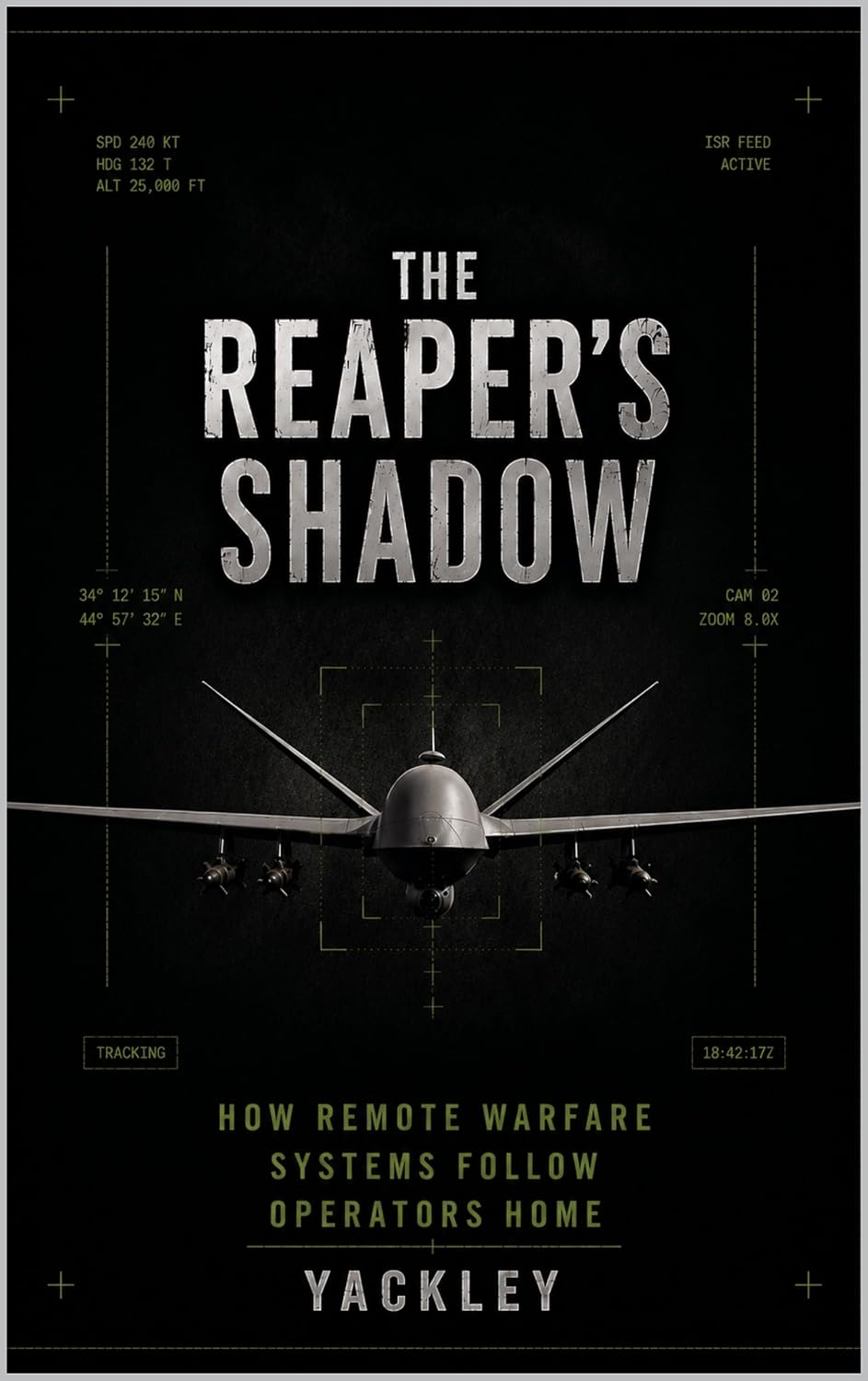
The Reaper's Shadow examines the operational demands of remote warfare, including continuous readiness, pattern recognition, compartmentalization, time-constrained decision-making, and responsibility, and asks what happens when adaptations built for that environment remain active outside it.
It is not a diagnostic instrument or clinical treatment manual. It is designed as a translation layer between operational experience and the operators, families, clinicians, educators, and leaders trying to understand it.
At 45 pages, the book is intentionally short enough to read in a single sitting and use as the basis for a guided professional or classroom discussion.
The following are potential instructional contexts, not claims that the book is a clinical treatment text or a comprehensive textbook for these disciplines.
Operational adaptation, cognition, attention, workload, and transition between environments.
The human system behind remotely piloted and distributed operations.
Context for understanding a distinctive operational population.
Organizational responsibility, personnel support, and the relationship between training and adaptation.
Operational context for clinicians and students working with military-connected populations.
Discussion of distance, responsibility, technology, and the human consequences of remote operations.
Identify cognitive and behavioral demands created by remote warfare operations.
Explain how an adaptation can remain useful in one environment while becoming problematic in another.
Discuss how operational context can change the interpretation of behavior.
Identify communication gaps between operators, families, clinicians, leaders, and institutions.
Apply a systems perspective to questions of transition, human performance, and remote warfare.
What changes when we treat behavior as an adaptation to an operating environment rather than examining the behavior in isolation?
Which patterns described in the book are useful inside remote-warfare operations? What changes when the operational environment disappears but the learned pattern remains?
Remote warfare creates significant physical distance from combat. Where does that distance meaningfully change the experience, and where might physical distance fail to produce equivalent cognitive or emotional distance?
What happens when a profession continually rewards anticipation, anomaly detection, sustained observation, and rapid interpretation? How might those habits appear outside the mission environment?
Why might an operator, family member, clinician, and commander interpret the same behavior differently?
If organizations deliberately train people to operate effectively in unusual cognitive environments, what responsibilities do those organizations have when personnel transition away from those environments?
Faculty, instructors, professional-development leaders, veteran-serving organizations, and military-connected programs may request an examination copy or inquire about classroom and organizational use.
The Reaper's Shadow is available in paperback and Kindle editions through Amazon. For recurring classroom, cohort, or organizational use, contact Tanner directly to discuss the most practical ordering approach.
Yackley, T. (2026). The Reaper's Shadow: How Remote Warfare Systems Follow Operators Home.